|
Table of Contents
Introduction
The intent
of this book is to provide you, the reader, with information
that will allow you to be more comfortable with your fireplace,
gas logs, or woodburning stove. General information about the
chimney is included as well. It is the wish of the authors that
this additional information will give you the confidence that
will allow total enjoyment of your fireplace or woodstove.
In order to
maximize your enjoyment of your fireplace or woodstove several
things are required:
The first,
and most important step in this process is to determine that
everything is properly installed and safe to operate. Without
this assurance you could never be fully at ease and able to
enjoy your fire without reservation.
The second
factor needed in order to fully enjoy your fire is the knowledge
that you have the proper information. The authors of this book
have over forty years of experience in this relatively new
industry. Their experience has led to the recognition that most
questions are very common and that there is a lot of homespun
misinformation around. This book is not an attempt to sell you
anything but will hopefully provide you with peace of mind and
the ability to enjoy your woodburning stove, gas hearth
appliance or open fireplace with confidence.
Back to Top
Starting Your Fire
Building a
fire in your fireplace or woodstove requires the use of tinder,
kindling and firewood. Always remember, before actually
lighting the fire check to be sure the damper is fully open.
The key to
building a fire is to think small. Starting your fire requires
the use of tinder and kindling. The tinder should easily ignite
with a match and begin burning. It will then ignite the
kindling followed in turn by the larger logs.
Newspaper
makes good tinder. Good kindling would be small dry sticks and
branches, the dryer the better. Kindling should not be more
than an inch in diameter.
We will
describe below two different methods for starting a nice fire in
your fireplace or woodstove.
Conventional fire building
- To lay the fire, arrange two small to medium size pieces of
wood on the grate, about six inches apart. Place some crumpled
up newspaper (tinder) between them and then cover the tinder
with several pieces of kindling. Don't scrimp on the kindling
as this is the most important part of starting the fire. Now
put one or two more pieces of firewood atop the other logs. If
you use two pieces, lay them at right angles to the first two.
Be sure to leave enough space between them to allow good air
circulation around the logs. Now light the tinder and within a
few minutes you will have a nice, hot, roaring fire.
Top down burn - Arrange
three large, dry logs in your firebox and place them up to six
inches apart depending on firebox size. Place them in the
fireplace the long way front to back, not across, to provide
good airflow for complete combustion. Place three more pieces
of dry wood that are slightly smaller across the tops of the
larger pieces, log cabin style. Continue building this
structure with increasingly smaller pieces of dry wood. The
structure can rise until it is about two-thirds of the way to
the top of your firebox. Aim for as many different sized levels
as possible. Important:
The top half of the log pile should be made up of small, branch
and twig sized pieces of dry wood. Top the pile with kindling
or wood shavings. When the dry kindling and shavings ignite,
the fire will work its way down to the larger pieces, provided
the wood is dry.
Regardless
of the method you choose, follow these three steps before
lighting your fire:
-
Insure that
the fireplace damper is open.
-
Twist up a
sheet of newspaper and light it, holding it as high up in
the fireplace as is reasonable. This will allow heat to
rise up the chimney quickly and establish a good draft. Be
careful not to burn yourself!
-
Once the
smoke is being drawn up the chimney, slowly move the burning
paper down and use it to ignite the kindling.
As the logs
burn, add more firewood as needed. Be careful not to add too
much wood. In a fireplace keep the top of the flames visible
below the fireplace opening. In a woodstove, keep the flames
confined to the woodstove itself. Flames roaring up into the
chimney could start a chimney fire.
Commercial
fire starters are also available and work well. They eliminate
the need for tinder and reduce the amount of kindling required.
These products are sold in small packets or blocks and ignite
easily. Never use liquid fire starters, such as charcoal
lighter fluid or other flammable liquids indoors as this is
extremely dangerous.
At the end
of the evening the fire should not be allowed to "smolder" out
because this creates creosote buildup in the chimney. When you
are through enjoying the fire, separate the logs by moving them
to the side of the fireplace or standing them on end in the back
of the fireplace. Close the screen or glass doors tightly. This
will reduce the amount of air flowing up the chimney while the
damper is open. Do not close the damper until you are sure the
fire and coals are completely out.
Back to Top
Fireplace Construction
Modern
fireplace construction usually falls into one of two groups,
masonry or factory-built.
Masonry
fireplace construction consists of hand laid brick or stone
built on-site. Masonry has been the standard for fireplace
construction for hundreds of years, and it lends a sense of
quality and permanence to the structure. Many homeowners feel
that masonry chimneys are indestructible, but, in fact, they are
not. Masonry chimneys are frequently damaged by chimney fires,
lightning strikes, or settling of the foundation. Masonry
chimneys can also be damaged by a natural aging process
resulting in deterioration of bricks and mortar accelerated by
water absorption and deposits of acids found in the combustion
by-products of some fuels.
Factory-built fireplaces and chimneys have gained popularity in
newer homes because both the material and installation costs are
generally lower than for masonry fireplaces. Factory-built
units are often referred to as "zero-clearance" or "prefab"
units. When properly installed, these units are safe and some
models are very efficient. It should be understood that they
will not last as long as a masonry fireplace and depending on
quality, use, and location should be expected to last twenty to
forty years before requiring replacement.
Whether
your fireplace and chimney is masonry or factory-built has
little to do with the countless hours of enjoyment you can gain
from using it. The keys to safe and enjoyable fireplace use are
proper construction followed by appropriate maintenance and
operation.
Many
variations of fireplace design are available and your choice may
be influenced by local or regional emission requirements. Many
areas of the country require low emission certification for
fireplaces and woodstoves. Rumford style fireplaces and masonry
heaters are two types being used because of their ability to
reduce emissions and provide increased efficiency in heating.
Additionally, local building code requirements may effect the
design of your fireplace, such as requiring an outside air
source for your fireplace or additional reinforcement in
earthquake prone areas.
A Typical
Masonry Fireplace
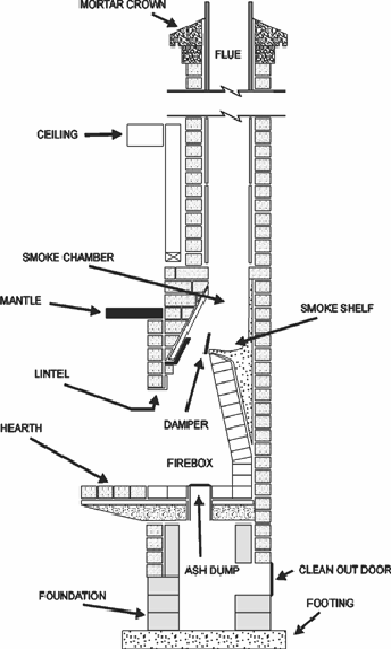
A
Factory-Built Fireplace
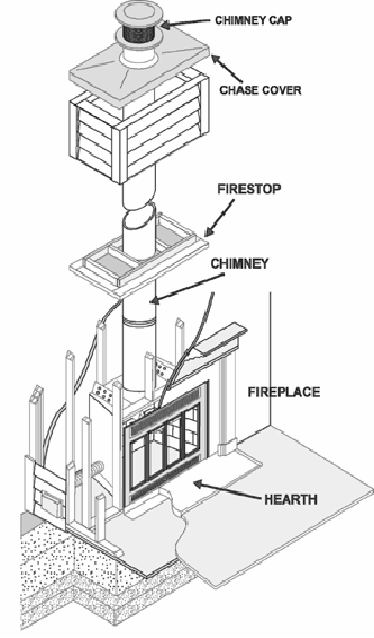
Back to Top
Chimney Caps
It has been
said a chimney without a cap is like a house without a roof.
Imagine how
much water would come into your home during a rainstorm if you
had a hole in your roof twelve inches square. Chimney flues may
be even larger than that, so where does all that water go? It
runs down the chimney and seeps into the bricks and mortar,
settling behind the firebricks in the fireplace. There is
little air circulation in the chimney (unless you're using it)
and no sunlight, so the inside of the chimney stays wet long
after the rain stops. This moisture erodes the mortar joints
and weakens the brick. Add to this a freeze/thaw cycle during
the cold months, and you have all the needed ingredients for a
deteriorating chimney.
Take our
word for it: even though you can't see the damage happening,
it's there, slowly deteriorating your beautiful fireplace and
chimney. This is a particularly important consideration if you
have a metal firebox incorporating a metal damper and smoke
shelf. All fireplace dampers made of metal are subject to this
deterioration as the water mixes with creosote and mild acids
are formed. Even chimneys serving woodstoves are in need of a
cover.
Listed
below are several good reasons to have a chimney cap:
-
Keep
out rain, snow and sleet.
-
Keep
out animals and birds.
-
Keep
out leaves, twigs and other debris which could lead to a
blockage or chimney fire.
-
Keep
sparks from leaving the chimney and igniting nearby
combustibles.
-
Help
eliminate wind induced downdrafts.
Chimney
caps are made from a variety of materials. The most common are
galvanized, stainless steel, and copper. Caps made of stainless
steel and copper will last much longer than those made of
regular galvanized steel and they normally carry an extended
warranty. Spending a little extra for a good quality chimney
cap will be money well spent and there will be no danger of rust
staining the chimney.
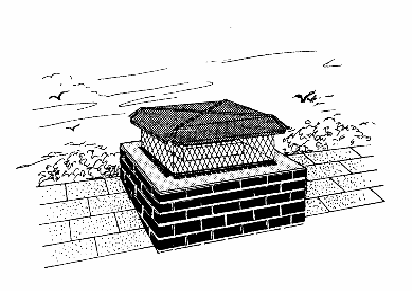
A Typical
Chimney Cap
Back to Top
Fireplace Accessories
Many
products are available that will help you improve the safety,
efficiency and convenience of your fireplace. Several of the
more common items are described in this chapter.
SPECIAL NOTE -
Professional installation is recommended for any type of heating
equipment, including fireplace accessories. If your fireplace
is a factory-built or "prefab" unit, be sure to use only
products approved or recommended by the manufacturer of the
fireplace. Using non-approved products can have a serious
effect on the safety of your fireplace.
Glass doors - Glass doors
perform several functions. The most obvious change is to
improve the appearance of your fireplace. A glass door also
helps reduce heat loss from your home, both during and after the
fire. Most glass doors have a mesh screen built in that will
prevent sparks and embers from popping out of the fireplace. Be
sure to close the screen while the fire is burning. If you
don't have a blower, you will want to leave the doors open to
get the greatest possible amount of heat out of the fireplace.
After you are through enjoying the fire, separate the logs so
they will burn out quickly and then close the doors. This will
stop heat loss from the home while the ashes are cooling down.
Blowers - There are many
types of blower units that can be added to most fireplaces. The
use of a blower can improve the overall efficiency of your
fireplace and supplement your home's heating system. If your
fireplace has a blower system, it may be appropriate to operate
the fireplace with the doors closed. In this manner the glass
doors will prevent room air from escaping up the chimney while
the blower pushes the heated air out of the fireplace.
Note: Do not burn the
fireplace with the doors closed unless the manufacturer of the
door recommends this. Some glass doors may not withstand the
high temperatures produced.
Grates - A grate is so
important it should not really be considered an accessory
because every fireplace needs a grate to burn properly. Be sure
to select the proper size grate for your fireplace. Most people
tend to purchase the largest grate that will fit into the
fireplace, but this is not recommended. Select a grate that is
approximately two-thirds the width of your fireplace and half
the depth for best results.
Dampers - Like grates, a
damper is really a "must item" for a fireplace. Without the
damper a great deal of heat will be lost up the chimney when the
fireplace is not in use. The normal alternative to a damper
would be a set of tight fitting glass doors. A damper can also
be used to control the flow of smoke and heat up the chimney.
By careful experimentation you can find the minimum damper
opening for various fire conditions. Always have the damper in
the fully open position when starting your fire. Once the fire
is established you can gradually decrease the damper opening.
Make these adjustments slowly and allow the fire time to
stabilize between adjustments. If any smoke or odors escape
into the room, the damper is not open enough. Pay close
attention to the damper setting as varying fire conditions will
require different damper settings. For example, as the fire
dies down, more smoke will be generated and a greater damper
opening will be required. Damper opening requirements will also
vary according to outside temperature and other atmospheric
conditions. With all of that said, probably the best thing to
do is to leave the damper completely open whenever using the
fireplace.
While most
dampers are located in the throat of the fireplace, there are
dampers that are attached to the top of the chimney. Top
mounted dampers are operated by a control mounted in the firebox
and connected to the chimney top damper by a cable or chain.
Chimney top dampers are often an economical alternative to
replacing a throat damper. Top mounted dampers will also keep
rain and animals out of your chimney when in the closed
position.
Screens - Another "must
item" for a fireplace is a screen. If you do not have a spark
screen for your fireplace, get one before you have your next
fire. A spark screen prevents sparks and embers from jumping
out of the fireplace. Many home fires have been started by
sparks coming from a fireplace that has no screen. The screen
may be a freestanding screen or one included with a glass
fireplace door.
Woodstoves - For those
wishing to supplement their existing heat with woodburning, we
recommend the purchase of a woodstove. For additional
information see the section devoted to woodstoves.
Firebacks - Cast-iron
firebacks are very useful for radiating additional heat from an
open fireplace, whether the fireplace burns wood or has gas logs
installed. Most homeowners who have added a fireback to their
fireplace report a dramatic improvement in heat output. A
fireback is not recommended, however, as an alternative to
repairing a damaged firebox.
Quality - We feel it is
worth saying a word about quality here. Most fireplace
accessories are available in a wide range of style and
quality.For example, glass doors are available with different
glass thickness, different metals (plated brass vs. solid brass)
and varying levels of quality. Fireplace grates can be made of
thin steels that will burn out in a year or two, or they can be
made from materials that will last a lifetime. Just like most
other products, you get what you pay for! A few extra dollars
will usually be well spent to get a product of higher quality.
Shop carefully and compare prices and features.
Back to Top
Gas Logs
Gas
fireplace logs are becoming quite popular. Their convenience
and cleanliness have convinced many woodburners to retire the
chainsaw and log splitter. Gas logs may be fueled by either
natural or propane gas. There are two basic types of gas logs
currently on the market. The two types are the "vented" and the
"unvented".
Vented gas
logs require a venting system while unvented gas logs are
approved for use without a venting system. The vented gas log
sets produce a very realistic and attractive fire. Quite often
a vented log set will be mistaken for a real wood fire. The
heat output from a vented log set will be similar to the heat
output from a comparable sized wood fire. Vented gas logs
generate soot and carbon which is deposited in the chimney.
These deposits require chimney cleaning just like a real wood
fireplace does.
Unvented
log sets are designed to provide much more heat output than a
vented log set. While the unvented log sets are generally not
as attractive as the vented type, they burn hotter and cleaner.
Unvented or vent free gas logs may be approved for installation
in a masonry wood burning fireplace or specific factory-built
fireplaces with the damper closed. Manufacturers may also
provide a separate firebox cabinet approved for installation
without a chimney. Unvented gas logs should not be used as a
primary source of heat because continuous use could cause air
quality problems in the home.
In addition
to gas logs, several other gas products have been developed for
fireplace use. Gas fired inserts have been designed to be
installed in fireplaces. These gas inserts usually have a
greater heat output than conventional gas logs and may resemble
a wood burning insert. Gas fireplaces have also been developed
for installation where no fireplace currently exists. These
fireplaces are usually more economical to install than a
woodburning fireplace and offer the convenience of gas as a
fuel. Gas fireplaces and gas inserts could be vented, unvented,
or direct-vent. Direct vent appliances draw all combustion air
from outside the home and also discharge their exhaust, or flue
gas, to the outdoors. Direct-vent appliances are ideal for use
in homes which are so air-tight they cannot provide sufficient
combustion air for the appliance.
When
installing any gas appliance consult the manufacturers
installation instructions and local codes. The use of a
qualified gas installer is recommended for the installation of
your gas hearth appliance.
Back to Top
Woodstoves
Woodstoves
come in a variety of sizes, shapes, and styles. Some are basic
designs, and others are very elaborate and, therefore, more
expensive.
Woodstoves
are usually installed in one of the following three ways:
Fireplace insert - Here a
woodstove is installed partially or completely inside a
fireplace, often with only the front portion of the stove
exposed. Some designs do project out enough to provide a
cooking surface and additional radiant surface area.
Hearth stove - These
stoves may be set on the hearth of the fireplace or on the floor
in front with some type of floor protection. The fireplace
opening or throat is usually sealed with a metal plate, and the
stove is vented through the plate with a length of stovepipe.
Many older installations simply have a sheet metal cover over
the fireplace opening with a pipe venting into the firebox of
the fireplace. This type of installation should be changed as
soon as possible since it represents the least efficient
installation from a performance standpoint and is potentially
the greatest threat of a chimney fire. Call your chimney sweep
and ask for recommendations.
Freestanding - This stove
is installed in the room with all of its sides completely
exposed and connected to a chimney built specifically for the
stove. The chimney may be of the factory built type or may be
made of masonry.
Many stoves
on the market today can be installed in more than one of these
methods. For example - most freestanding stoves can be
installed as hearth stoves, and many insert stoves can be
installed as freestanding stoves.
We
recommend the freestanding stove whenever possible; however, it
has been our experience that most homeowners choose the insert
or hearthstove. Freestanding stoves are more efficient because
they are free to radiate heat on all sides. The exposed
connector pipe from the stove to the chimney will also radiate
heat into the room. Properly installed freestanding stoves are
generally easier to maintain than either an insert or a hearth
stove.
If you
already have a fireplace, you can install an insert or hearth
stove without putting up a new chimney. But beware, there are
considerable drawbacks to this such as the potential for
increased creosote deposits. Increased volume and glazed
creosote deposits will mean more frequent and aggressive
cleanings, often twice a year. Proper cleaning of the chimney
requires that the stove be removed to provide access to the
firebox and smoke chamber. Since these installations are harder
to service and therefore represent greater expense, the
homeowner tends to perform the required servicing less often,
thereby creating a higher risk of chimney fires. Freestanding
stoves are both more efficient and easier to maintain. Most
freestanding woodstoves can be maintained by an able homeowner
with only a few special tools. This ease of maintenance will
lead to safer overall burning conditions.
If you
already have or plan to vent a fireplace insert or hearth stove
into your fireplace chimney, we highly recommend installing a
properly sized chimney liner from the woodstove to the top of
the chimney.
Keep in
mind that your fireplace was designed to vent a large, hot fire
with plenty of air reaching the fire. When you install either
an insert or hearth stove into the fireplace, the burning
characteristics of the fireplace change. Instead of the hot,
open fire normally found in a fireplace you will generally have
a slow smoldering fire in the woodstove. In addition, the
typical fireplace flue is usually much larger than what the
average woodstove requires, and this leads to greater cooling of
the flue gases and high rate of creosote buildup. This buildup
will often be in the form of a tarry creosote that is difficult
to remove from the chimney and yet poses a serious fire risk.
Because of these design considerations, it is unlikely you will
be able to achieve the efficiency your heater is designed to
provide without a liner from the stove to the top of the
chimney.
There is
one more type of stove that deserves a mention, and that is the
pellet stove. A pellet stove is a special stove designed to
burn small dense wood-like pellets. These pellets automatically
feed from a hopper to the combustion chamber at a rate set by
the operator. Pellet stoves are simple to operate. Typically
they will burn a steady fire for 24-36 hours between fueling.
Due to the very low emissions of pellet stoves they can be
vented through the wall with a specialized vent. Pellet stoves
are available as freestanding, hearth or insert stoves.
Back to Top
Woodstove Testing
Woodstoves
currently being sold are required to undergo two types of
testing; safety and emissions.
Safety
testing is performed by agencies such as Underwriter's
Laboratories to determine if the stoves are safe when installed
and operated according to the manufacturers recommendations.
Emissions
testing is required by the Environmental Protection Agency to
determine if stoves can achieve an acceptable (low) level of
particulate emissions. The requirement for emissions testing
forced considerable design changes for stove manufacturers in
order to pass the tests. These design changes have resulted in
fewer stoves being produced. However, the approved stoves are
cleaner burning and more efficient, but are also more expensive
than earlier non-approved models.
If you are
planning to purchase a new woodstove, discuss safety and
emissions testing with the dealer to determine if the stove you
are considering has the required approvals. Getting a heater
that is the proper size is important to your long term
satisfaction and will provide the greatest potential for the
stove to operate at peak performance.
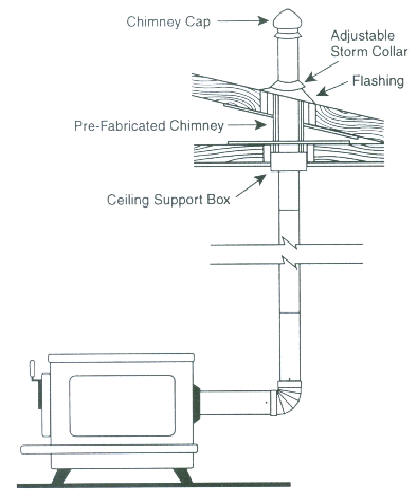
A Freestanding
Stove
Back to Top
Woodstove Accessories
Many items
are available which will make your woodstove more enjoyable,
more efficient, easier to operate, safer or any combination of
the above. This chapter will describe some of the common
woodstove accessories.
Grates - A small grate or
andirons will generally aid in starting and maintaining a fire
in your stove. Consult the owners manual for your stove for
recommendations concerning the use, type, and size of grate.
The quality of the grate should be given consideration as
woodstove grates are subjected to high temperatures for long
periods of time.
Note: Some woodstove
manufacturers recommend that grates not be used in their stoves.
Screens - A good quality
screen is recommended for all woodstoves that can be operated
with the doors in the open position. It is a good practice to
burn this type of stove with the doors open for approximately 30
minutes each time you load the stove and for an hour at least
once a day. This "open burning" helps control creosote buildup
and reduce glazed creosote deposits. This practice is
appropriate if used consistently and should only begin after a
thorough chimney cleaning.
Thermometers - A
thermometer is a useful indication of stove performance. Two
types of stove thermometers are available:
Probe type
- This type is for stovepipe and has a probe into the flue which
provides an accurate measurement of flue gas temperature. The
thermometer should be placed into the stovepipe as far from the
stove as practical. Ideal flue gas temperatures would be
between 400-900 degrees.
Surface
Mount Thermometers - These are available and can be used where
probe type thermometers are impractical. A surface mounted
thermometer will only indicate approximately 50% of the actual
internal temperature.
Catalytic Combustors - A
catalytic combustor is a device designed to be built into or
added to a woodstove. Its purpose is to reduce the temperature
required to consume the particulate in the smoke so that a large
portion of the flue gases will be consumed prior to entering the
chimney. When properly incorporated into the stove design, a
catalytic combustor significantly improves the overall
efficiency and reduces the emission of pollutants into the
atmosphere. Retrofits, or "add-on" catalytic combustors for
existing stoves are not always as successful due to variations
in the stove design. Catalytic combustors need periodic
replacement, usually after 5,000 to 10,000 hours of use. You
will notice a marked decline in the performance of your stove as
the catalytic combustor nears the end of its useful life. It
will also be necessary to maintain the combustor by cleaning the
grid periodically to allow proper flow and operation. This
would be the time to inspect the combustor for damage.
An
important consideration when operating a stove with a catalytic
combustor is "light-off". The catalytic combustor needs to be
preheated to approximately 750 degrees for 20 minutes before it
is engaged or brought into the path of the flue gases. Failure
to achieve a proper light off is the most common user error with
catalytic combustors.
Covered Ash Container - A
metal can with a tight fitting lid is a very handy tool for
removing ashes, hot or cold, from the fireplace or woodstove.
Be sure to dispose of them very carefully as coals insulated in
the ashes will stay hot for days. Be careful not to dispose of
hot coals near the house and be especially cautious on windy
days. If you have a dedicated area for ash disposal, such as
your garden for example, you can wet the ashes to be sure they
are completely out before leaving them.
Gloves - Woodburners gloves are a necessity when
operating a woodstove. Adding fuel to a wood stove can be a
trying experience, resulting in burns, without this handy item.
Back to Top
Moving The Heat
Hopefully
your fireplace or woodstove will generate a lot of useful heat.
Many times, though, homeowners experience an intolerable buildup
of heat in the room where the fireplace or woodstove is located
with little of it getting to the rest of the home. The natural
circulation of this excess heat depends on many factors, as
follows:
Location of the chimney and
stove - A centrally located chimney and stove will work
better than a chimney at one end of the home. Interior chimneys
will also radiate more heat into the home than a chimney which
has three sides exposed to the cold outdoor temperatures. It
also has the added advantage of staying warmer and not cooling
the flue gases as rapidly.
Design of the home - Open
floor plans allow heat to seek out the cooler areas easier than
floor plans with lots of walls, small doorways or other
barriers.
Windows and insulation -
Large or multiple windows will allow abnormal amounts of heat
to escape to the outdoors, as will poorly insulated walls.
Multiple stories - Homes
with more than one floor level allow the heat to rise to the
upper floors, often to the point of making the first floor
colder than desired.
The items
above are some of the factors that influence how well the heat
will circulate. Unfortunately, most of those factors cannot be
changed once the home is built. Let's look at some things that
we can do to help improve the circulation of heated air.
Place a fan
at floor level blowing into the room with the woodstove or
fireplace. Yes, we did say into the room. The cooler air will
always be on the floor so you want to blow cooler air into the
room which will cause the warmer air at ceiling level to come
out and circulate to other rooms. If you have the fan blowing
out of the room at floor level, you will only pull cooler, floor
level air out of the room.
Install a
"mini-fan" in the doorway of the room with the fireplace or
woodstove. This fan should be blowing out of the room since it
should be located up high where the warm air is.
Registers
or vents can be installed high in the wall between two rooms
allowing the heat to flow from one room to another. These vents
may also be installed in the floor allowing the heat to rise
from one level to another. Stairways will act as natural
chimneys allowing the warm air to rise to the upper levels of
the house. Floor vents are not usually needed because the
natural "stack-effect" in the home will allow the heat to rise.
These vents may be purchased with or without "booster" fans to
assist the natural air flow. "Booster" fans are recommended for
through the wall vents but are generally not required for floor
vents. When making changes of this sort the best results will
be achieved when encouraging the natural convective cycle within
the home.
Ceiling
fans can be used to help circulate the heat. They are not very
effective for moving heat from room to room; but when installed
in the room with the fireplace or woodstove, they will bring the
hot air down from the ceiling and make the room more
comfortable.
Another
method you may wish to try is running your heating system in the
"fan only" position if it is so equipped. This will circulate
the air in the home without running the heat portion of the
system. This works well for some people but fails to impress
others.
Back to Top
Types of Chimney Deposits
Chimney
deposits can be found in a variety of forms but can be divided
into three basic types as shown below:
Soot - Soot is primarily
composed of carbon particles but may also contain ash. Soot has
a soft texture and will be black or brown in color. The
flammability of soot will depend on the concentration of soot
and ash. Soot, since it is made of carbon, is combustible. Ash
is noncombustible.
Creosote - Creosote can
be defined as a combustible deposit in the venting system which
begins as condensed wood smoke including tar fogs and vapors.
Creosote is a by-product of incomplete combustion. Creosote
will be hard brown or black and form either curly, flaky
deposits or even bubbly deposits in the venting system.
Creosote is flammable.
Glaze - Glaze is a form
of deposit that presents itself as a shiny, tarry substance.
Glaze can form puddles or drop down and make formations that
resemble black icicles. Glaze is the most dense type of wood
burning deposit and, therefore, represents the greatest amount
of fuel to burn in the event of a chimney fire. Glaze is also
the most difficult type of deposit to remove from the chimney.
Back to Top
Removing Chimney Deposits
Enter the
chimney sweep! The main job of a chimney sweep is to remove
chimney deposits and evaluate the overall condition of the
venting system. A competent chimney sweep should be able to
provide recommendations that will improve the safety and
efficiency of your appliance and venting system.
There are
several reasons to remove chimney deposits:
-
To
ensure that the appliance vents properly to the outdoors.
-
To prevent
chimney fires.
-
To reduce or
eliminate chimney odors.
-
To remove
blockages that could cause carbon monoxide gases to enter
the home.
-
To prevent
deterioration of the chimney interior caused by acids in the
deposits.
There is no
single answer for how often a chimney should be cleaned. The
National Fire Protection Association (NFPA) recommends that
chimneys be inspected at least once a year and cleaned as
necessary. The required cleaning frequency will depend on
amount of use, the type of installation, the type of fuel, and
the burning habits of the operator. Chimneys should be cleaned
when accumulations of soot and creosote approach or exceed 1/4
inch. Accumulations of glaze in excess of 1/8 inch should be
removed. Frequent, at least annual, inspections are the only
way to know when the chimney requires cleaning.
Chimney
sweeps employ a variety of cleaning techniques to remove chimney
deposits. The method chosen or recommended for your chimney
will depend on the type of deposits. Several cleaning methods
are described below:
Standard Cleaning - This
is the standard or normal cleaning method and involves the use
of brushes to clean the chimney walls. A powerful, well
filtered vacuum is used to prevent soot and creosote from
entering the home. This type of cleaning is effective for soot
and ordinary creosote deposits but has little effect on glaze
deposits.
Mechanical Cleaning -
Mechanical cleaning involves the use of wire brushes, plastic
cables or special chains rotated at high speed by an electric
motor. Mechanical cleaning is often employed to remove hard
creosote or glaze deposits. Mechanical cleaning should only be
attempted by professional sweeps familiar with the use of this
type of equipment. The improper use of mechanical cleaning tools
can be hazardous to the operator and the chimney.
Chemical cleaning - Some
sweeps prefer to use chemical cleaning instead of or in
conjunction with mechanical cleaning. Special chemicals are used
to loosen or dissolve heavy deposits of creosote and glaze.
Chemical cleaning should only be attempted by trained
professional sweeps. However, there are a few chemicals
designed to be sprayed directly into the fire on a daily basis
and your sweep may recommend one of these.
As you can
see, there are several methods a professional sweep can use.
Don't expect a sweep to offer all of the services shown above,
but a professional sweep will be able to offer the standard
manual cleaning and at least one of the other methods for
dealing with excessive creosote and glaze deposits. Sweeps will
usually charge an additional fee for any of the special cleaning
methods.
If you have
a woodstove vented into a fireplace flue without a properly
sized chimney liner, it is likely that your sweep will recommend
one of the additional cleaning methods. Other times when
additional cleaning methods might be recommended are:
-
If you are
burning large quantities of green or wet wood.
-
If you are
repeatedly allowing the fire to smolder overnight.
-
After
removing a woodstove from a fireplace.
-
After a
chimney fire.
Back to Top
Creosote Buildup
Creosote is
simply unburned wood particles and condensed flue gases which
deposit in the chimney interior. The rate of creosote buildup
is affected by residence time, smoke density, and stack
temperature.
Residence Time -
Residence time is the time the smoke remains in the venting
system. Residence time is affected mainly by flow. Flow is
simply the amount of air moving through the chimney. Within
certain limits, the greater the air movement, the lower the
residence time. Abnormally high flow can result in turbulence,
which can actually increase residence time. Low flow, usually
caused by oversized flues, results in longer residence time and
higher rates of creosote buildup. The less time the smoke stays
in the chimney, the less likely it is to deposit on the chimney
walls. This is desirable for maintaining a clean chimney.
Smoke Density - Smoke
density is the amount of smoke produced by the fire. When
combustion air is restricted, it causes incomplete combustion
resulting in high smoke density. Creosote is simply unburned
particulates and gases leaving the fire. When smoke density is
high, creosote deposits will be high. Without smoke there is no
creosote.
If you can
visualize an open campfire, it generally produces very little
smoke because it has plenty of air to complete the combustion
process. With complete combustion, which rarely occurs, there
is no smoke and no creosote.
Stack (Chimney) Temperature
- Stack temperature is the temperature of the interior walls of
the chimney. Stack temperature is affected by the amount of
heat allowed to go up the chimney. The warmer the walls of the
chimney the less the creosote can adhere to them. Stack
temperature is also affected by the size and location of the
chimney. If the chimney is on an exterior wall as opposed to an
interior wall, it will constantly be subjected to outside
cooling effects. If the chimney is oversized, it will require
more heat to keep the surface of the walls warm due to the
increased mass. With this thought in mind, you can see how a
very large chimney that will never fully warm up would have the
potential to cause excessive creosote deposits.
Back to Top
Chimney Fires
Chimney
fires are no fun, and we're sure you don't want to experience
one on your own. Most people that have wish they hadn't.
Like any
fire, chimney fires vary in size and severity. On one extreme,
it is possible to have a chimney fire without even knowing it.
On the other extreme, a chimney fire may leave nothing more of
your home than a pile of ashes around the chimney. Fortunately,
this is uncommon.
The average
chimney fire will make a loud roaring noise, often described as
a train or jet going through the home. The roaring noise is
caused by the sudden rush of air going into the chimney to feed
the fire. A column of flames will often be seen coming out the
top of the chimney. Pieces of creosote will often be seen
flying out the top of the chimney, and these may ignite the roof
or other nearby combustibles. You may also hear popping or
cracking noises inside the chimney indicating damage to bricks,
mortar and flue liners. In some cases a dense black smoke
coming from the chimney is the only indication that a chimney
fire is in progress.
Listed
below are the things you should do if you have a chimney fire.
-
Call the
fire department. Hopefully you won't need them but don't
wait until you do before calling.
-
Notify
everyone in the house and be prepared to evacuate if
necessary.
-
If you have
a fireplace with glass doors, close the doors and the vents.
If you have a woodstove, close the doors and the air
inlets. Do not close the damper of either a woodstove or a
fireplace.
-
If flames
are visible at the chimney top, hose down the roof but not
the chimney. Spraying water on a hot chimney will very
likely damage it.
-
Call a
chimney sweep before using the chimney again.
Don't be
misled into believing that a chimney fire is a good way to clean
a chimney. A chimney fire is a serious occurrence and can be
very damaging to a chimney. Often a well constructed chimney
will confine the first chimney fire to the chimney itself, while
repeated chimney fires increase the likelihood of damage to the
home. Chimney fires, even small ones, will very likely damage
the chimney making it unsafe to use.
Back to Top
Chimney Inspections
In addition
to chimney cleaning, another important service performed by most
chimney sweeps is an inspection of the chimney. Chimney sweeps
may include an inspection as part of a regular chimney cleaning
or may offer it as a separate service.
The
National Fire Protection Association recommends that chimneys be
inspected annually and cleaned as needed. This is a good
guideline and, if followed, would eliminate most chimney fires
and other chimney problems.
There are
other times when a chimney inspection should be performed, and
we have listed some of them below:
-
Immediately
after a chimney or furnace fire.
-
Whenever the
service of the chimney is being changed. Adding a woodstove
to a fireplace, or converting from an oil to a gas furnace,
or installing gas logs.
-
Whenever you
are considering the purchase of a home with a chimney. Make
sure the chimney inspection is performed before closing.
-
Whenever you
suspect any type of storm damage. Example - Lightning
struck chimney, or high winds blew the cap off.
The results
of a chimney inspection should be presented to you in written
form. Most sweeps have a special form for this purpose. In
addition to performing a visual inspection, many sweeps have a
video camera which is lowered into the chimney for a more
detailed, close-up look at the chimney interior. This method
can also produce photos or a video tape for more complete
documentation. If you are interested in this service, be sure to
request it, as this is generally not included in a routine
inspection.
Back to Top
Chimney Repairs
This
section of the book is designed to introduce you to common
chimney repairs for both masonry and factory-built "prefab"
fireplaces and chimneys.
Masonry
chimneys
Ash dump area - If your
fireplace has an ash dump, it should be free of any combustible
framing within the ash dump area. The next time you empty the
ash dump check it out with a strong flashlight. If any part of
the house framing is visible, DO NOT use the fireplace until
this is corrected. The ash dump should have a tight fitting door
installed where you scoop the ashes out and a tight fitting
cover installed in the firebox floor where you push the ashes
down into the ash dump. Both the ash dump door and ash dump
cover should be made of noncombustible materials. If either of
these are damaged or missing, they should be replaced or
repaired before using the fireplace again.
Chimney cleanout - A
chimney cleanout is different from an ash dump, but the two are
often confused. A chimney cleanout is an area where debris can
fall from the chimney flue and accumulate. Chimney cleanouts
are usually only found in straight flues serving either a
freestanding woodstove, furnace or boiler. This cleanout should
extend at least eight to twelve inches below the thimble, and it
too should be sealed with a tight fitting noncombustible door.
Replace or repair this door if it is damaged or missing.
Firebox area - The
firebox is the area of the fireplace where you build the fire.
The firebox should be lined with refractory firebrick. The
firebrick may be cracked or the mortar around the bricks
weakened by hot fires or years of use. Rainwater coming down
the chimney will also weaken the mortar holding the firebrick
together. The firebox area takes the greatest abuse during
fireplace use, and you should watch this area closely. If the
firebrick are loose or if any of them have cracks more than a
1/4 of an inch wide, the firebox should be repaired before using
again. Mortar joints between the brick which have eroded back
more than 1/2 inch also indicate the need for repairs. Firebox
repairs are the most common repair required of fireplaces.
Depending on frequency of use, expect to repair the firebox
every five to ten years. Firebox repairs are an ordinary
maintenance item for fireplace owners, just as painting and
reroofing are common repairs for homeowners.
Dampers - Every fireplace
should have a damper. If yours does not, you should consider
having one installed. The damper keeps heated air from escaping
up the chimney when it is not in use. An open fireplace without
a damper will allow more heated air to escape than would be lost
by leaving a window open all winter. The damper also helps keep
some of the heat generated by the fire from escaping up the
chimney, while still allowing the smoke to escape. For repairs,
replacement parts are generally available for dampers less than
twenty-five years old. Your local chimney sweep or masonry
supply company should be able to help you locate these parts.
If parts are no longer available or if you do not have a
damper, the best replacement is usually a top sealing damper.
Your local chimney sweep is the best person to contact for
installation of a top sealing damper.
Smoke chamber - The most
common repair to a smoke chamber would be parging of the smoke
chamber walls. Parging is a coating of mortar applied to the
bricks to smooth the interior walls. During a chimney fire the
parging is often cracked and damaged. An experienced chimney
sweep or brick layer should be able to parge or reparge your
smoke chamber.
Flue - The most common
type of flue repair is relining. There are many reasons to
consider relining your chimney. Several of the more common
reasons are:
Repairing damage -
Chimney flues are often damaged by chimney fires or lightning
strikes but can also be damaged by settling or deterioration of
the chimney.
Proper sizing - Chimneys
often need to be resized to perform properly if the intended use
of the chimney is changed after construction. An example of
this would be using a fireplace flue to vent a woodstove. If
the oversized fireplace flue is used to vent the woodstove,
excessive creosote and tar glaze may result. The woodstove will
not perform as well as it could unless it is connected to a
properly sized flue. If you have, or plan to have, a woodstove
installed in a fireplace, you should consult with a professional
chimney sweep to determine if your flue needs relining.
Upgrading old chimneys -
Chimneys that were built without flue liners should be lined for
safety’s sake. Regardless of their condition, unlined chimneys
are always improved with the addition of a liner.
Converting fuels - When
furnace or boiler installations are converted from one fuel to
another, relining becomes an important consideration. If you
have converted your heating system from oil to gas heat, your
chimney could present unknown hazards unless you have had the
chimney properly inspected and maintained. After oil to gas
conversions the sulphur deposits left from years of oil burning
mix with water vapor produced by the new gas appliance. This
forms an acid which attacks the bricks and mortar in the
chimney. The brick and mortar deterioration can lead to
blockages in the venting system that may allow carbon monoxide
to spill into the home. This deterioration occurs rapidly and
should not the ignored.
The common
relining materials are:
-
Clay flue
liners
-
Stainless
steel
-
Aluminum
-
Cast-In-Place
Lets take a
look at each one of these.
Clay flue
liners - Clay flue liners are the primary choice for new
construction but can also be used for relining. Relining with
clay flue liners may require cutting open one wall of the
chimney to remove the old liners and install the new ones.
Since clay flue liners come in two foot lenghts they must be
properly seated and mortared at each joint. Lowering the clay
liners down from the top may not produce satisfactory results
and is only possible in straight chimneys.
Stainless
steel - Stainless steel is probably the most common relining
material. Stainless steel liners are available in round,
rectangle or oval shapes and can be made of either flexible or
rigid construction. Flexible liners are useful when the chimney
contains bends or offsets. Stainless steel liners are made of
several alloys, the most common are 304, 316, 321 and AL 29-4C.
If you are considering having a stainless steel liner installed,
the installer should be able to recommend the most appropriate
material to use based on the intended use of the liner.
Stainless steel liners are insulated to help maintain flue gas
temperature within the liner and prevent heat transfer to nearby
combustibles. Stainless steel liners can be insulated with
either a ceramic fiber blanket or a mixture of Portland cement
and vermiculite. The latter is mixed like mortar and either
pumped into the chimney or carried to the roof in buckets and
poured in. This type of insulation hardens and helps secure the
liner in place while sealing cracks in the chimney structure.
Cast-In-Place - This type of liner involves pouring a special
mixture of cement and insulation material around a form to
create a new flue liner. There are two common methods of
cast-in-place liners. The first uses a long inflatable bladder
to form the flue. The bladder is installed in the chimney and
sealed at the bottom. The mix is then pumped around the former
and allowed to cure. After curing, the former is deflated and
removed, leaving a new flue within the chimney. Another method
involves pouring the mix around a vibrating form and drawing the
form up through the chimney as the mix is poured. The size of
the form determines the size of the flue. Cast-In-Place liners
strengthen and insulate the chimney in one process, while
providing a new flue.
Aluminum -
Masonry chimneys may also be lined with aluminum liners.
Aluminum liners should only be used to vent certain gas fired
appliances. Aluminum liners are not suitable to vent gas logs
installed in woodburning fireplaces.
If you are
considering having a new liner installed in your chimney,
consult with an experienced installer about the best type of
liner for your particular needs.
Mortar crown - The mortar
crown is the concrete or mortar pad at the top of the chimney.
Its purpose is to shed water and prevent it from entering the
chimney chase. A proper mortar crown will overhang the edges of
the chimney by an inch or more to prevent water from running
down the sides of the chimney. If your mortar crown is cracked
or damaged, your local chimney sweep can probably repair it for
you.
Factory
Built Systems
Repairing
factory built fireplaces and chimneys is a lot like repairing
automobiles. Just as you can't substitute car parts from one
manufacturer to another, you can't substitute fireplace parts
from one manufacturer to another. This sometimes poses a
problem if the manufacturer of your factory built system has
gone out of business. It is very important to use only the
recommended parts for a factory built system. Something as
seemingly insignificant as substituting a different set of glass
doors can have a serious effect on the overall operation and
safety of the system.
Before
replacement parts can be ordered, the manufacturer and model
number of the factory built system must be determined. There is
usually a nameplate on the unit somewhere, but if the nameplate
is located in the firebox it may become unreadable after a few
years. You may have an owner's manual that will contain the
required information. The owner’s manual is an important
reference and should be kept as long as you own the fireplace.
Often your local chimney sweep will be able to identify the unit
for you and also locate and install the needed parts.
Common
repair items in factory-built fireplaces include the refractory
wall and floor panels, the mesh screen or curtains, the chase
cover (the metal “pan” covering the top of the chimney
structure), and the chimney cap. Even the fireplace and chimney
will not last forever and we are seeing average useful service
from these units in the fifteen to forty year range.
Back to Top
Fuels
This
chapter will describe common fuels for fireplaces and hearth
appliances.
Wood - Wood is certainly
the most common fuel for stoves and fireplaces. Wood is usually
the most readily available fuel and can be the least expensive.
If you have access to standing wood (trees), you can stockpile
your wood supply inexpensively. It is also good exercise and
lots of fun to spend the day in the woods cutting firewood!
There are good books available about cutting and splitting
firewood for those interested. If you are going to cut down
trees, make sure you have the permission of the landowner. In
many areas it may be possible to have a truckload of logs
delivered that you can cut and split into firewood. This
eliminates the need to haul the wood from the forest to your
home and still provides significant cost savings over buying
"ready to burn" wood. And finally, you can order your wood, cut
and split, from a wood dealer. See section on "Buying
Firewood".
Let's look
at some interesting figures about firewood. Bone dry, wood has
approximately 8600 BTU's per pound. This figure varies little
from species to species. However, firewood is never bone dry.
The ideal moisture content for firewood is between 15 and 25
percent. Assuming this, firewood will actually have a BTU
potential between 5500 and 6500 BTU's per pound. Since the
actual heat potential of the wood is determined by weight, the
more dense hardwoods contain greater heat potential when
compared to an equal size piece of soft wood. In other words, a
cord of oak contains more potential BTU's than a cord of pine.
More moisture in wet or green wood requires more BTU's to
maintain combustion. This results in less available heat since
many of the BTU's will be used to disperse the moisture instead
of providing heat.
Coal
- Coal can be used as a fuel for stoves and fireplaces.
Before attempting to burn coal, make sure your stove or
fireplace is properly designed for coal burning. Use cannel
coal in a grate in a fireplace. We do not recommend burning
coal in a stove not designed for coal burning. Stove design is
quite important as improper combustion of coal produces carbon
monoxide, a highly toxic gas. Minimum design considerations for
coal stoves are:
-
A properly
sized firebox usually lined with firebrick
-
A coal grate
incorporating a shaker
-
Secondary
air inlets in addition to the primary air inlet for the
express purpose of efficiently burning the gases generated
by burning coal
-
An ash pan
Types of
Coal
While many
types of coal exist, the only acceptable types for stoves are
anthracite and bituminous coal. Anthracite is recommended
because it burns so much hotter and cleaner with fewer
clinkers. Anthracite coal is available in several sizes, with
the recommended size for stoves being "chestnut" or "pea".
Bituminous coal is dirty to handle and produces much more soot
and smoke. Bituminous coal should only be used when anthracite
is not available. Some manufacturers recommend only one type of
coal. Although some coal stoves can burn wood, most wood stoves
will not burn coal properly or safely.
Coal is
sold by weight, with the standard measure being the ton. The
heating value of one ton of anthracite compares equally with the
following fuels:
-
One cord of
dry hardwood.
-
Approximately 160 gallons of #2 fuel oil.
-
24,000 cubic
feet of natural gas.
-
3,800
kilowatts of electricity.
This will
allow you to compute and compare heating costs in your area.
Coal
Storage
A coal
storage area should be kept dry and free of any other
combustible materials. A weather tight coal bin is recommended
and can be built easily. A bin 4 feet square and 4 feet high
will hold nearly two tons of coal.
To anyone
seriously interested in heating with coal we recommend that you
read up on the subject and develop a complete understanding of
coal burning. One recommended book is "Heating With Coal" by
John W. Bartok, Jr.
Manufactured Fuels
There are
three common types of manufactured fuels available:
-
Compressed
wood logs.
-
Wood wax
logs.
-
Wood
pellets.
Compressed
wood logs are made by "compressing" or "densifying" wood chips
or coarse sawdust. These logs use no binders and are held
together by the pressure exerted upon them during manufacturing.
They are usually 3-4 inches in diameter and 12-18 inches long.
These logs have a comparable heat output to cordwood but
generally produce less smoke and ash. Compressed logs may be
burned in stoves or fireplaces, as you can burn two or three at
a time. Compressed wood logs have a very dry, wood like
appearance.
Wood wax
logs are made by molding sawdust into log like form and adding
combustible binders such as wax or paraffin. Because of the wax
content these logs have a BTU rating of approximately 15,000 BTU
per pound, much higher than cordwood. These logs should only be
burned one at a time and should not be used in woodstoves. Wood
wax logs are commonly available at convenience and grocery
stores. Recent testing has shown that when burned properly,
wood wax logs produce less creosote and smoke than an average
cordwood fire.
Wood
pellets are made by compressing small wood chips, shells of nuts
or material like the pits of cherries into pellets. The process
here is the same as for compressed wood logs. The pellets will
be 1/4 to 1/3 inch in diameter an 1 to 2 inches long. Like
compressed wood logs, their heating potential is similar to
cordwood because the pellets are made from pure wood with no
binders added. These pellets are designed to be burned in
special stoves designed to feed the pellets from a storage
hopper to a special combustion chamber or “firepot”. Pellets
are usually packaged in 40-50 pound bags and may be purchased by
the bag or by the ton. The pellet fuel is clean, convenient to
handle, and one bag will last 1 to 2 days. Emissions from
pellet stoves are so low that pellet stoves are currently exempt
from EPA certification. Because the pellets are so very dry
there is more heat available for heating your home.
Fuel Gas - Gas hearth
appliances may be fueled with either natural or propane gas.
Natural gas, where available, is supplied through pipelines to
individual homes. Natural gas is sold by the therm, a measure
equal to 100,000 BTU’s. Propane (LP) is supplied in containers
stored on your property. Propane is sold either by the pound or
gallon depending on local custom. Propane has 21591 BTU’s per
pound and 91547 BTU’s per gallon.
Back to Top
Buying Wood
Wood is
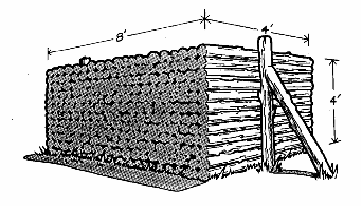
generally sold by the cord, a measure of volume. A cord is 128
cubic feet of wood, usually stacked in a pile that measures 4
feet by 4 feet by 8 feet. However, the configuration of the
pile is not important as long as it measures 128 cubic feet. It
will be difficult to determine the volume of wood you receive if
it is simply thrown on the ground.
As
discussed previously, a pound of bone dry wood has 8600 BTU's.
This varies only slightly from species to species. Therefore,
if a cord of oak and a cord of pine were the same price, the oak
would be a better buy because the heavier oak contains more
BTU's. Remember that it takes some of your available BTU's to
boil off the water in the wood, so the drier the wood the more
available heat you will have.
While
firewood is generally sold by volume, it may also be sold by
weight. Volume or weight are the only recommended ways to
purchase firewood. Other units of measure, such as a "truckload"
are ambiguous and open to debate. Whose truck and how big is
it? If you buy by volume, measure it before accepting. If you
buy by weight, ask to see a statement of the delivered weight.
Generally,
the best time for buying wood is spring or early summer because
this allows time for proper seasoning. The price should also be
lower during these months. By buying early, you know your
firewood will be properly seasoned when it's time to light your
first fire in the fall.
For proper
seasoning, wood should be cut, split and stacked at least six
months prior to the burning season. The more cut/split surfaces
the better.
One way to
determine if wood is seasoned is to bang two pieces together.
Seasoned wood will produce a clear ring while green wood will
give only a dull thud. Also look for cracks on the ends of
split wood radiating out from the center. These cracks indicate
shrinkage and moisture evaporation from the wood. Wood that has
a very strong odor is definitely not seasoned. When ordering
wood be specific about what you want. Verify what you are
buying, ask questions, for example:
-
Is it hard
wood or soft wood? What species?
-
Is it a full
cord? How will they “prove” it?
-
Is it
seasoned? How long has it been cut and split?
-
Will they
stack it? Does this cost extra?
-
Is it cut to
the proper length for your fireplace or woodstove?
Inform the
salesman that you intend to inspect the delivered wood. Protect
yourself, learn how to identify different species.
If
possible, deal with established wood dealers. Ask friends and
neighbors where they bought their wood, and if they were
satisfied.
Back to Top
Wood Storage
When your
wood is delivered it must be stacked to determine if you have
received the proper quantity. A nice rectangular pile can be
measured accurately and stored under cover.
The best
location for your wood to season will be an area that receives
good sunlight and also has good air flow. Normally a
freestanding pile is going to dry at a faster rate than one
backed up against a shed because the movement of air can more
readily draw the moisture from the wood. If your wood is
purchased early (ideally before you have finished using your
stove or fireplace), there will be no need to cover it until the
beginning of the burning season. Remember that smaller pieces
of wood dry better and will make it much easier to start your
fires quickly.
We have
found the best method for stacking wood to be the log cabin
style where each row of wood is opposite the one above and below
it. This method allows for good air circulation, giving you
drier wood when winter arrives.
You should
locate the bulk of your wood away from the house. This will
keep termites and snakes away from your home. However, when the
burning season begins keep about a weeks worth of wood in a
convenient and dry location.
ONE CORD OF
WOOD
Back to Top
Fire Safety Products
Smoke detectors - Every
home should have at least one smoke detector. The most
important location for a smoke detector is near the sleeping
area(s). If the home has two or more sleeping areas, each
should have a detector.
Multistory
homes should have a detector on each floor, including the
basement.
Some
important tips:
-
Test
your detector monthly with a candle or cigarette.
-
If your
detector is battery powered, keep spare batteries on hand
and replace promptly when needed.
-
Replace the
detector promptly when defective.
-
Explain to
children what the detector is and what to do when it sounds.
-
After
installing your detector, plan and practice family fire
drills.
Fire extinguishers - Two
5 pound ABC type fire extinguishers would be a good all purpose
type to have. It is normally a good idea to locate one
extinguisher in the kitchen since this is where most fires
start. The location should be visible so there is no difficulty
finding it should the need arise. Be sure to check the
extinguishers you now have to be sure they have maintained
adequate pressure. Most units will lose pressure over time and
will certainly need to be replaced or recharged after use.
If your
extinguisher shows low pressure, it would be appropriate to use
it for a fire drill. Have all family members participate, so
confidence and reason will override the emotion experienced in
the event of a fire.
Chimney fire extinguisher
- There is also a fire extinguisher specifically designed to put
out a fire in the chimney. This extinguisher emits a dense
smoke that is drawn up the chimney, suffocating the fire. It
may be necessary to use more than one to extinguish a severe
chimney fire.
Back to Top
Trouble-shooting Guide
For
discussion of chimney performance problems, we have divided
these problems into four main areas.
-
Fireplace or
woodstove smokes all the time.
-
Fireplace or
woodstove smokes sometimes.
-
Fireplace or
woodstove difficult to start.
-
Foul odors
from fireplace or woodstove.
Years of
handling fireplace performance complaints have led us to group
problems into these four areas. We feel most problems will
center around one of the these topics.
FIREPLACE OR WOODSTOVE SMOKES ALL THE TIME
Constant
smoking problems are often the easiest to diagnose while being
the hardest to correct. Many constant smoking problems are the
result of improper construction or design and may require
extensive modification of the chimney system to correct.
Below is a
description of common design problems which may lead to constant
smoking problems.
Fireplace opening too large
- The fireplace opening should be sized based on a relationship
with the chimney flue. An ideal fireplace opening would not be
more than ten times the cross sectional area of the chimney
flue. Example - If the inside measurement of the flue is 10
inches by 10 inches equaling 100 square inches, then the
fireplace opening should not exceed ten times this, or 1000
square inches. You will have to go to the chimney top to
accurately measure the chimney flue. Determine the fireplace
opening by multiplying the fireplace opening height times the
width. Example - A fireplace opening 36 inches wide by 27 inches
high equals a fireplace opening of 972 square inches. This would
be a proper matchup for the 10 x 10 flue. If the fireplace
opening is too large, it can draw in more combustion air than
the chimney flue can vent. This problem can best be solved by
reducing the fireplace opening. The fireplace opening can be
reduced with a noncombustible shield at the top of the fireplace
opening to lower the effective opening height. Often a three to
four inch reduction in opening height will make a noticeable
improvement in fireplace performance. Another method to reduce
the fireplace opening is to install glass doors. The fireplace
opening could also be reduced by rebuilding the firebox to
smaller dimensions.
Firebox too shallow - If
the firebox is too shallow, the smoke may roll out near the top
of the fireplace opening rather than entering the smoke chamber
normally. The best solution to these problem would be
installing a "hood" at the top of the fireplace opening which
protrudes about four to six inches past the fireplace profile.
This would help capture the smoke and direct it up the flue
rather than into the room.
Lintel too high - If the
fireplace lintel (the steel bar supporting the top of the
fireplace opening) is too high, it may allow smoke to roll out
of the fireplace opening instead of going up the flue. The
lintel should be at least six inches below the damper frame. If
it is not, try installing a shield as described above in
"Fireplace opening too large".
Fireplace throat improper
- If the fireplace throat (opening into the smoke chamber) is
not constructed properly, severe smoking problems may result.
The throat may be located too far forward or simply not be
large enough for the fireplace. Throat problems generally
require rebuilding the firebox and throat area to correct this
problem. The opening of the throat should be at least one tenth
the fireplace opening, however, a larger throat is common.
Smoke chamber improper -
The smoke chamber serves to funnel smoke from the fireplace
opening into the flue. Improper design here can lead to
numerous problems. The smoke chamber can be too deep, too tall,
or too wide. It may also be extremely rough and irregular in
construction. NFPA 211 (National Fire Protection Association's
standard for Chimneys, Fireplaces, Vents, and Solid Fuel
Appliances) recommends that smoke chambers should not be taller
than the fireplace opening width, nor deeper than the fireplace
opening. It further states that the smoke chamber walls should
not incline more than 45 degrees from vertical. The walls of
the smoke chamber should be smooth to reduce turbulence. Most
building codes require that smoke chamber walls be parged. "Parging"
is a coating of mortar applied to the brick to give the smoke
chamber a smooth surface. The flue should start at or very near
the top center of the smoke chamber and should not have any
radical offsets or bends. Corner fireplaces are a special
problem here as the smoke chambers tend to be quite large and
irregular. Most smoke chamber design problems are difficult to
correct and will require specialized skills.
Chimney flue too small
- If the chimney flue is too small, it will not allow
smoke to exit the woodstove or fireplace fast enough and can
lead to serious smoking problems. As stated above, the
fireplace and flue must be sized in a proper relationship. (See
"Fireplace opening too large") It will be easier to reduce the
fireplace opening than to enlarge the fireplace flue. If you
have a woodstove, the flue should be at least as large as the
flue collar on the stove. If it is not, you must either replace
the flue with a larger one properly sized for the woodstove or
replace the woodstove with one designed to operate with a
smaller flue. Sorry, no cheap fixes here!
Flue too short - Short
chimneys can often lead to smoking problems. A short chimney is
defined as one less than ten feet tall above the fireplace
opening or woodstove flue outlet. The best thing to do here is
raise the chimney.
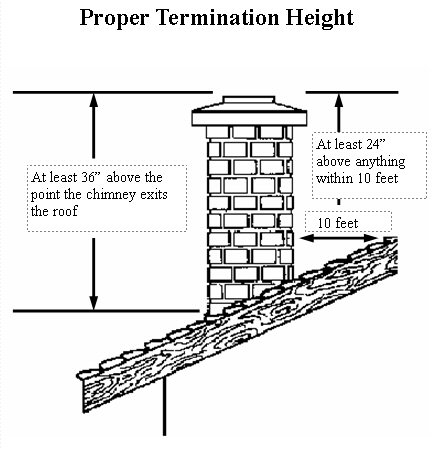
Improper termination height
- A chimney should terminate at least three feet above the point
it passes through the roof so that any sparks exiting the
chimney have time to cool before landing on the roof. The
chimney should also terminate at least two feet higher than any
portion of the building within ten feet. This rule keeps the
chimney above nearby obstructions that could cause smoking
problems. Please realize that this is only the minimum accepted
termination height and may not always be enough. If your
chimney is lacking in either of these areas, and you are having
a smoking problem, you should consider raising it.
Proper
Termination Height
Airtight homes - Smoke
cannot rise up the chimney any faster than air can be drawn into
the home to replace it. Normally the home will allow sufficient
air leakage around doors and windows to satisfy the chimney.
However, if your home is especially airtight, it may not allow
enough makeup air to enter the home at a rate sufficient to
promote good flow in the chimney. If you suspect this problem,
open a window near the fireplace the next time you have a fire.
If this cures the problem, consider installing an outside air
supply so you don't have to leave a window open when having a
fire in the fireplace.
Obstructions and blockages
- If the chimney is blocked or obstructed the smoke cannot pass
through it or exit. The chimney could be obstructed with leaves
and pine needles which fell into the chimney or were carried
into the chimney by an animal or bird building a nest. An
accumulation of creosote can block the chimney and possibly
block the screen in the chimney cap, if you have one. Creosote
blockages are often indicated by a problem which gradually
worsens to the point that smoking is constant. Sudden blockages
can occur in older, deteriorating chimneys if a portion of the
interior chimney walls collapse. An experienced chimney sweep
should be able to remove any blockages or obstructions in your
chimney and make recommendations for repair.
Damper - Make sure the
fireplace damper is open! This is an easy thing to forget if
you don't have fires on a regular basis.
FIREPLACE
OR WOODSTOVE SMOKES SOMETIMES
Erratic or
occasional smoking problems can often be the hardest to detect
but often are easy to eliminate once detected.
Competing vents -
Anything which removes air from the home can cause smoking
problems, especially in fireplaces. Draft in fireplaces is
quite low compared to draft in woodstoves and as a result
fireplaces are more prone to smoking. A competing vent could be
the kitchen or bathroom exhaust vents or attic exhaust vents,
especially if they are of the powered type. Other devices that
can cause problems include the clothes dryer, a central vacuum
system, or a whole house fan. The furnace return vent can also
cause problems if the duct system is not properly designed and
installed. By drawing air from the house these devices can
cause a flow reversal. If you suspect that competing vents are
causing your woodstove or fireplace to smoke, make sure all
vents are off during your next fire. If this cures the problem,
install an outside air supply to the house, so that it can draw
outside air as needed.
Temperature - Draft can
be defined as the difference between indoor and outdoor air
temperature. A fireplace that works well when it is very cold
outside may smoke when the outdoor temperature approaches the
indoor temperature. If you suspect this problem, simply do not
use the fireplace or woodstove on moderate days. Usually a
temperature difference of twenty degrees between indoor air and
outdoor air is sufficient to produce reliable draft.
Wood Supply - Green or
wet wood can cause smoking problems. If you must burn green
wood, mix it with some dry, well seasoned wood. Also keep
enough wood for your next fire in a dry location or well covered
to prevent rain or snow from getting to it. (Also see section
on buying and storing firewood.)
Wind Induced Downdrafts -
Wind related smoking problems are the most common type of
occasional smoking problem. Wind induced downdrafts only occur
when the wind is blowing and usually only effect a particular
chimney when the wind is blowing from a certain direction.
(Example - chimney only smokes when wind blows from the east,
works fine all other times.) Two distinct types of wind related
downdrafts occur when either high pressure or turbulence
surrounds the chimney top. High pressure around the chimney can
occur when the chimney is located upwind of some obstruction
taller than the chimney. As the wind flows toward the
obstruction it tends to backup, causing a higher pressure. If
this pressure is higher than the pressure in the chimney, it can
force smoke down the chimney. On the other hand, if the chimney
is located downwind of an obstruction, turbulence will be
created as the wind flows over and around the obstruction. If
the chimney top is located within the region of turbulence, wind
can be forced down the chimney. Wind induced smoking problems
usually result in short, "gusty" bursts of smoke coming out of
the fireplace or woodstove. A chimney cap will often eliminate
problems resulting from wind diverted directly down a chimney
flue and is a good thing to try first since chimney caps are
reasonably inexpensive. Even if the cap doesn't eliminate the
smoking problem it gives you several other benefits. There are
special caps which are designed to eliminate downdraft problems.
These caps act to create a vacuum within the chimney as the
wind blows across the cap. The harder the wind blows, the
better the cap works. Note:
Do not install attic turbines on a chimney as they are not
intended for that purpose. Other solutions to wind induced
downdrafts would be to raise the chimney above the region of
turbulence if possible, or remove the obstruction causing the
turbulence. (Example - Trimming or cutting back of tree
branches.)
Fire starting practices -
Smoking problems can be caused by the way a fire is started and
maintained. Once, while investigating a smoking problem, we
discovered that the fire only smoked when the husband built the
fire and worked fine if the wife built the fire. A quick review
of some basic fire techniques eliminated this problem. For more
information see the section on "Starting Your Fire".
Flow reversals - Flow
reversals can cause smoking problems that are either constant or
erratic. A flow reversal occurs when the pressure surrounding
the woodstove or fireplace opening is lower than the pressure in
the chimney. This can be caused by several things. Leaks or
cracks in the upper portions of the home can allow warm rising
air to escape faster than it is replaced in the lower portions
of the home. This can lower the pressure downstairs around the
fireplace, which could cause smoke flow in the chimney to
reverse or come out into the room. This same thing could happen
if someone upstairs decided to open a window to let in fresh
air. This type of problem can be solved by either closing or
sealing cracks in the upper portions or installing an outside
air supply for the fireplace or woodstove.
Another
type of flow reversal can be created when two chimneys are
located close together. Make up air for the chimney in use can
be drawn down the unused flue, pulling smoke from the flue in
use. The solution would be to close off the unused flue with a
tight damper and install an outside air supply.
As erratic
smoking problems are the most difficult to diagnose, it will
often be necessary to make observations during several different
fires. Some things to make note of are:
-
Wind
direction and velocity
-
Outdoor
temperature
-
Condition of
the firewood
-
Operation of
any competing vents
-
When the
smoking occurred (beginning of fire, end of fire, all the
time)
-
Who built
the fire
-
Who was home
at the time
Diagnosing
smoking problems can be very challenging and frustrating; but if
you succeed, you will be able to enjoy your fireplace or
woodstove that much more. Be patient, be observant, and good
luck. While we have attempted to outline the more common
problems, it would be impossible to outline them all.
When all
else fails, you may try installing a powered exhaust fan at the
chimney top, but be careful here. If you are depending on a
powered exhauster to prevent smoking, imagine what would happen
if you had a nice fire going when the power went out.
Additionally, a powered exhauster will probably draw all or
most of the heat from the fire up the chimney. Powered
exhausters should only be used as a last resort and with the
advice of a professional sweep. Some building codes do not allow
the use of powered exhausters for manually fired appliances.
It would be
prudent to call your chimney sweep if you experience a problem.
They should be able to professionally diagnose problems and
recommend a solution.
We have
mentioned the use of an outside air supply several times in the
above paragraphs and would like to more fully explain this
concept. Outside air supplies are used to eliminate negative
pressure near the fuel burning appliance. Negative pressure in
the area of the appliance or fireplace opening can also cause
many problems for natural draft chimneys. Negative pressure can
overcome the natural draft in the chimney. When this happens a
flow reversal occurs. When a flow reversal occurs, air from
outside is being drawn down the chimney to relieve the negative
pressure at the base of the chimney. This negative pressure can
be caused by many factors, several of the more common are:
-
House stack
effect - Stack effect is the tendency of warmer air to rise
within a structure, creating lower pressure in the lower
areas of the building. Leaky areas near the top of the
house increase the stack effect. Stack effect works against
chimney draft.
-
Competing
vents - Competing vents which exhaust air to the outdoors
can cause negative pressure in the house. Common examples
are the clothes dryer, central vacuum systems, kitchen and
bath exhausts, and attic exhausts.
-
Other
appliances - Air being consumed by one fuel burning
appliance may cause negative pressure in the area of another
appliance. This is particularly a problem in homes with
fireplaces on two different levels. Air exhausted by the
upper fireplace may create negative pressure near the lower
fireplace. If the chimneys exhaust close to each other the
downstairs fireplace may draw in smoke from the upstairs
fireplace as well as air.
-
Wind loading
- Wind creates pressure areas around a building. When wind
strikes the building it creates high pressure on the
windward side and low pressure on the downwind or leeward
side. If the building has leaks on the downwind side it can
draw air out of the building, creating negative pressure
indoors.
Outside air
supplies can be natural or mechanical. Natural draft outside
air supplies are undependable. Because wind direction is always
changing the air inlet terminal may be surrounded by high
pressure one day and work very well while the following day it
may be surrounded by low pressure and actually draw air from the
house. For this reason we recommend mechanical introduction of
make-up (outside) air when the use of outside air is required.
The use of mechanical outside air insures that air moves from
outdoors to indoors to create the desired effect. A mechanical
outside air system can be as simple as a small electric fan
connected to a short section of ductwork with a weatherproof
hood on the outside wall.
Back to Top
House Stack Effect
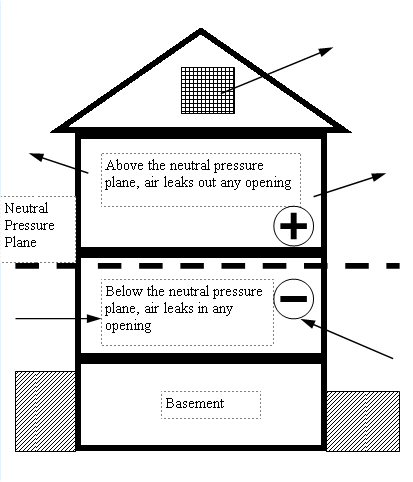
The diagram
above shows how house stack effect can work against chimney
draft. Warm air rises and escapes out of any opening in the
upper portion of the house. The escaping air must be replaced
with outdoor air which will enter through openings in the lower
part of the home. A neutral pressure plane develops in the
house where air above the neutral pressure plane is under
slightly positive pressure and the air below the neutral
pressure plane is slightly negative. The neutral pressure plane
rises and falls becuase of atmospheric conditions such as wind
and temperture. The neutral pressure plane also moves toward
the area of most leakage. Large leaks or opening a window in the
upper portion of the home causes the neutral pressure plane to
rise while opening a basement or first floor window or door
causes the neutral pressure plane to fall. Fireplace or
woodstove openings below the neutral pressure plane may allow
air to come down the chimney. Under these conditions a flow
reversal will occurr. If the fireplace or woodstove is operating
smoke may be drawn into the home. To eliminate this problem seal
(or close) any leaks in the upper portion of the house or
provide a fresh air source in the lower portion of the house.
Back to Top
Wind Loading
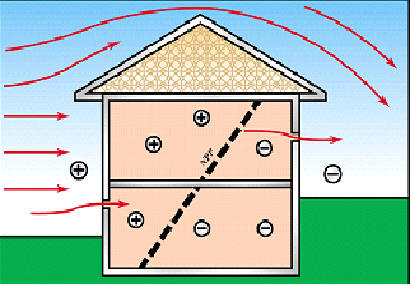
The diagram
above shows how wind can effect pressure inside and outside of
the home. When wind strikes a building it creates high pressure
on the windward side and low pressure on the downwind side. Air
will be forced indoors through openings on the windward side and
drawn outdoors through openings on the downwind side. If
leakage throughout the home is roughly equal this will not
effect natural draft appliances. However, if openings to the
downwind side are larger, or someone opens a door or window
downwind, large quantities of air may be drawn from the house.
This will increase the level of negative pressure in the home
and may cause natural draft appliances such as fireplaces,
woodstoves or furnaces to backdraft. By the same token, opening
a window on the windward side of the home increases pressure in
the home and will increase draft for these same appliances.
Back to Top
Chimney Odors
Chimney
odors can be a common and recurring problem for many homeowners,
especially during periods of warm or humid weather. The first
thing to realize about chimney odors is that they are always
present to some degree, but the natural draft during cold
weather carries the odor up the chimney so you don't notice it.
During warm weather the natural draft in the chimney can be
reversed so that the airflow is into the home instead of out the
top of the chimney. In addition to weather, anything that
causes a flow reversal in the chimney can draw chimney odors
into the home. The odors will usually be greater when it is
raining or very humid outdoors. This is probably because the
moisture amplifies the odor. Just as a wet dog will usually
have a greater odor, the porous brickwork will absorb moisture
and retain the odors for a longer period of time.
Several
steps can be taken to eliminate or reduce chimney odors. Listed
below, in order, are the steps you should take to cure a
"stinking chimney".
-
Have the
chimney cleaned to remove as much of the odor causing
creosote as possible. Glazed creosote is a special problem
here because it is the hardest type of creosote to remove
and also produces the worst odors due to its high moisture
content.
-
Install a
chimney cap if you do not already have one. This will keep
the chimney interior dry but will not keep the humidity out.
-
Use a
special deodorant to combat chimney odors. Your chimney
sweep should be to able to furnish this.
-
Slightly
open a window in the room with the fireplace. If the
chimney odor problem is being caused by a flow reversal this
may allow the negative pressure in the home to be satisfied
by fresh outdoor air instead of air drawn through the
chimney.
-
If the first
four steps have not cured the problem, try sealing the
entrance to the flue at the chimney top. This will help
prevent airflow in the chimney. Be sure to remove this seal
before using the chimney! A chimney top mounted damper is a
good way to accomplish this.
Back to Top
Chimney Stains
The brick
above and around the fireplace opening can sometimes be stained
by smoke puffing out of the fireplace opening. Unfortunately,
brick is porous and the stain will often be quite difficult to
remove. You should be prepared to clean the entire brick front
since any cleaner strong enough to remove stains from brick will
also remove all buildup of normal household dust or dirt from
the brick. Cleaning only the dirty portion of the brick will
leave the remaining portion with a different appearance.
Several
cleaning methods are:
-
Commercially
available brick cleaning products, be certain to follow the
instructions carefully.
-
Oven
cleaners - some work well.
-
Muriatic
acid - be certain to protect all surfaces and furnishings
other than the brick, wear gloves and goggles, and
completely rinse any acid residue from the brick.
Back to Top |